'%20fill='%23FFFFFF'%20fill-rule='nonzero'%3e%3cg%20id='User'%20transform='translate(305.750000,%2028.500000)'%3e%3cpath%20id='Shape'%20d='M10,0%20C4.4797258,0.00620755447%200.00620755447,4.4797258%201.77635684e-16,10%20C0.00938473715,15.5189555%204.48104446,19.9906153%2010,20%20C15.5228475,20%2020,15.5228475%2020,10%20C20,4.4771525%2015.5228475,0%2010,0%20Z%20M16.082472,15.770264%20C14.9367487,13.4596888%2012.5799723,11.9985982%2010.0009342,11.9999964%20C7.42189607,12.0013946%205.06670523,13.4650399%203.923488,15.776856%20C2.42807156,14.2261103%201.59478073,12.1543109%201.59997563,10%20C1.59997563,5.3608081%205.3608081,1.6%2010,1.6%20C14.6391919,1.6%2018.4000223,5.3608081%2018.4000223,10%20C18.4049827,12.1511749%2017.5740167,14.2201438%2016.082472,15.770264%20Z%20M10,4%20C8.0117749,4%206.4,5.6117749%206.4,7.6%20C6.4,9.5882251%208.0117749,11.2%2010,11.2%20C11.9882251,11.2%2013.6,9.5882251%2013.6,7.6%20C13.6,6.64522064%2013.2207154,5.72954655%2012.5455844,5.05441559%20C11.8704534,4.37928463%2010.9547794,4%2010,4%20L10,4%20Z'%20/%3e%3c/g%3e%3c/g%3e%3c/g%3e%3c/svg%3e)
Directions to the Seville Airport
Address of Seville Airport
Travel Information: Your Journey to Seville Airport (SVQ)
You have booked your flights, reserved a parking space, and now all that's left is to start your journey. It is necessary to arrive at the airport with sufficient anticipation to check in luggage, pass security controls, and complete all formalities. Unexpected events can always occur and cause delays, so being well-prepared is essential. Here, we want to provide you with traffic information and useful links so that nothing prevents you from arriving on time at Seville Airport.
Key Access Routes to the Airport
Seville Airport is situated northeast of the city and is primarily accessed via the **A-4 motorway (Autovía del Sur)**, which links Seville and Madrid.
- **From the South (Cádiz and Jerez de la Frontera):** Drive on the A-4/E-5 motorway and take the **Exit 533** marked "Aeropuerto."
- **From the West (Huelva):** Head towards Seville on the E-1/A-49 and continue on the SE-30 ring road until you merge onto the A-4, finally taking the **Exit 533** for the Airport.
- **From the North (Badajoz):** Take the A-5 towards Mérida and merge onto the A-66/E-803. Take the SE-30, merge onto the A-4, and exit at **Exit 533** for the Airport.
- **From the East (Córdoba):** Head towards Seville on the E-5/A-4 and take the specific **Exit 532** for the Airport.
Approximate Driving Times (Optimal Conditions)
Below you will find the driving times from major cities under optimal weather conditions:
- Seville (Centre) to Seville Airport: 9 km / 15 minutes
- Cádiz to Seville Airport: 130 km / 1 hour 30 minutes
- Huelva to Seville Airport: 105 km / 1 hour 20 minutes
- Badajoz to Seville Airport: 228 km / 2 hours 25 minutes
- Córdoba to Seville Airport: 138 km / 1 hour 30 minutes
- Málaga to Seville Airport: 210 km / 2 hours 20 minutes
Check Real-Time Traffic Conditions:
You can check the real-time traffic status in Spain using the following map. Use the filters to select the province you are interested in:
Continuous Traffic Map (DGT)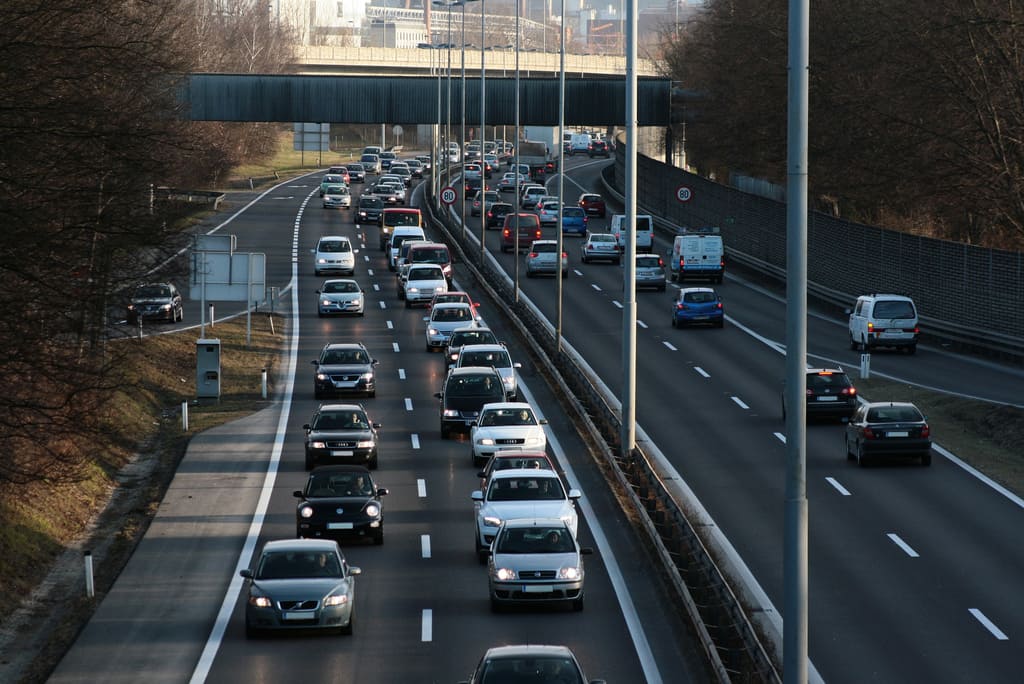
Useful Information: Vehicle Preparation and Spanish Rules
Before starting your journey, it is advisable to perform a check of your vehicle. Checking the oil, coolant, and ensuring all lights are working correctly will help you avoid potential incidents. Do not forget to also verify the tire pressure and replace any that are excessively worn, including the spare wheel.
Keep in mind that certain roads, particularly sections of the AP (Autopista) network, include tolls.
Fuel
You will have no problem refuelling at any gas station in the country if your vehicle uses petrol or diesel. If your car requires LPG, be aware that it is less frequent in the city for safety reasons. We advise you to fill up before starting your journey, not only to ensure a full tank but also because prices may be higher if you fill up on the motorway.